
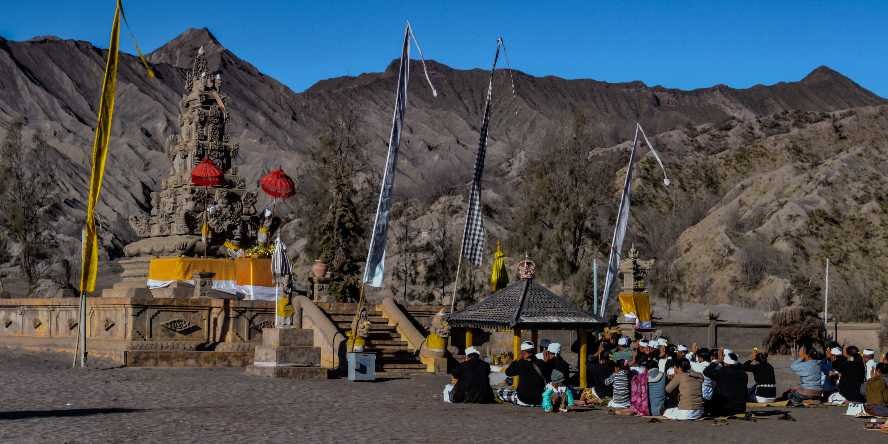
YADNYA KASADA
HISTORY BEHIND THE SACRIFICE CEREMONY IN BROMO
ABOUT BROMO AND HINDU-TENGGER
As stated above, the people of Tengger are mainly Hindus, but not the same kind as the one in Bali Island. In general, Hindus believe in Polytheism, there are three principal Gods in Hindu, that is Shiva (The Destructor), Brahma (The Creator), and Vishnu (The Protector). Tenggerese people believe in Hindu-Brahmaism, so they believe that Brahma is superior to the other God. Whereas in Bali, they believe in Hindu-Shivaism, Shiva as their main God.
In Tenggerese they didn’t use the caste system which separated people by their social/religious status. They didn’t cremate the deceased either because they believe it is prohibited that another smoke floats higher than the sulfuric smoke coming from Mount Bromo.
HISTORY OF YADNYA KASADA
YADNYA KASADA, The sacrificial ceremonies that go on for years in Mount Bromo started with the very same ancestor. Long story short, Rara Anteng and Jaka Seger got married and didn’t have any children for years. So they meditate in Bromo and ask Brahma to give them children, promising they would sacrifice one of the children to Him.
After some time passed, they finally got children – 25 of them, which – according to the myth – were born one day after another. The parents who’s overwhelmed by joy, forgets that they made a promise to Brahma. One day, one of their children named Joko Kusuma has a dream about sacrificing himself for the good of their village.
He agreed to sacrifice himself (jumped into the crater of Bromo) and before doing so, he passed a message to the people of Tengger to continue giving offerings to Bromo every 15th of Kasada month in the Tenggerese calendar to avoid misfortune and bring peace to the village. The people of Tengger listen and do so for years until now, on the 15th of Kasada they’ll go from their houses bringing their crops, farm animals, money, for offerings. They go to the temple near Mount Bromo, doing prayers, and then climb up to the crater and throw their offerings to the crater. One of the unique traditions is that some of them would go down the steep and slippery crater to collect some of the sacrifices.
