

East Java holds amazing landscapes that attract tourists from around the world, one of which is Ijen Crater. Explore the wonder of nature by discovering the history of Ijen Crater. In this article we will provide you with historical information of:
- Formation of the Ijen Caldera
- Creation of Ijen’s Acid Lake
- The Blue Fire Phenomenon
- Sulfur Mining History
- Ijen Crater’s Record as a Tourist Destination
Formation of the Ijen Caldera
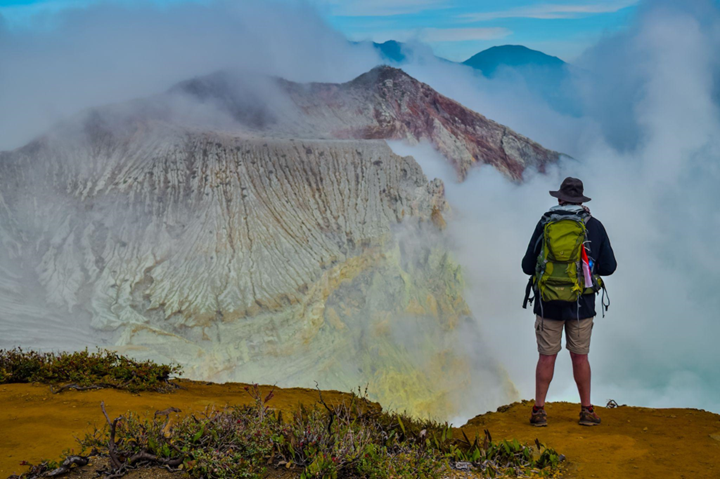
The Ijen Caldera, located in East Java, Indonesia, is the result of a series of powerful volcanic events that shaped the region over tens of thousands of years starting in the paleolithic era. It is part of the Ijen volcanic complex, which includes several stratovolcanoes and craters, the most famous being Mount Ijen and its acidic crater lake.
Creation of Ijen’s Acid Lake
Kawah Ijen’s acid lake was formed within the crater of an active volcano that is part of the Ijen volcanic complex. Over time, powerful eruptions carved out a large caldera, and rainwater, along with condensed volcanic steam, gradually filled the crater. As volcanic activity continued, gases like sulfur dioxide and hydrogen sulfide bubbled up through the lake, dissolving into the water and creating one of the most acidic natural lakes on Earth, with a pH as low as 0.2.
The lake’s striking turquoise color comes from its high sulfur and mineral content, and it’s known not only for its extreme acidity but also for the rare phenomenon of “blue fire” — flames that appear when sulfuric gases ignite at night. Despite the harsh environment, local miners harvest solid sulfur from the crater, making the lake both a scientific curiosity and a site of human endurance and labor.
The Blue Fire Phenomenon
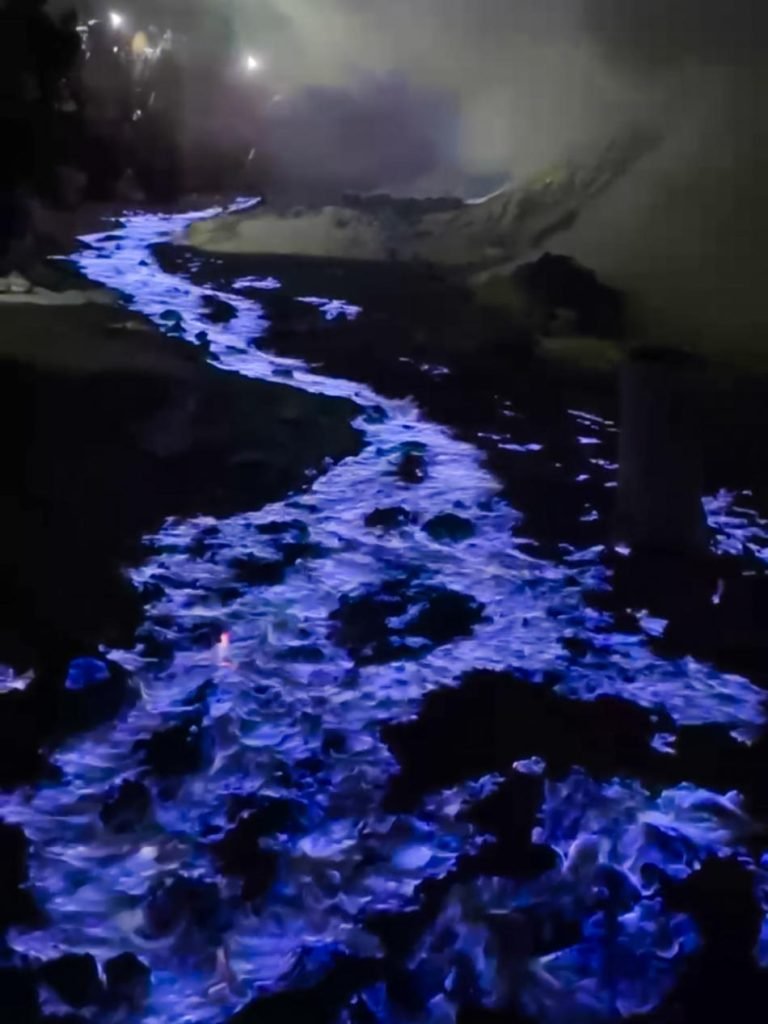
The blue fire at Kawah Ijen is a rare phenomenon caused by the combustion of sulfuric gases escaping from the volcano’s crater. When these gases, heated to over 360°C, come into contact with air, they ignite, producing bright blue flames — sometimes forming glowing rivers of burning liquid sulfur. Unlike lava, this is not molten rock but flammable volcanic gas, making it visually striking but dangerously toxic.
Though locals have seen the flames for centuries, the phenomenon remained largely unknown internationally until the early 2000s, when photographers and scientists documented it. Since then, it has drawn global attention as one of the few places on Earth where such blue fire is visible, especially at night. Its eerie glow, while beautiful, reflects the intense volcanic and chemical activity within Ijen’s crater, which also houses the world’s largest highly acidic lake.
Sulfur Mining History
Sulfur mining at Kawah Ijen has a long and grueling history, dating back to the early 20th century, when Dutch colonial authorities began exploiting the volcano’s rich sulfur deposits. Located inside the crater, near the acidic lake, the deposits are formed by volcanic gases condensing and solidifying into bright yellow sulfur around active vents.
Miners use basic tools to break off chunks of sulfur and then the porters carry loads weighing 70–140 kg up steep, rocky paths from the crater floor to the rim and then down the mountain. Despite the extreme conditions — toxic gases, acidic fumes, and rugged terrain — the process uses a hybrid system—part traditional, part industrial—that adapts Frasch principles to volcanic terrain. While the sulfur is used in various industries (such as fertilizer, cosmetics, and food processing), the miners often endure hazardous conditions for low pay, highlighting a stark contrast between natural beauty and human hardship.
Ijen Crater’s Record as a Tourist Destination
Ijen Crater became a tourist destination in the late 1990s and early 2000s, after gaining attention for its striking turquoise acid lake, active sulfur vents, and rare blue fire phenomenon. Previously known mainly for its harsh sulfur mining operations, it began attracting hikers, photographers, and eco-tourists as images of its surreal landscape spread globally.
By the 2010s, Ijen was a major draw in East Java, especially for pre-dawn treks to witness the blue flames and sunrise. Tourism has grown steadily, though concerns remain about environmental impact and the difficult conditions faced by sulfur miners.
